
In short
- Counter: no point more than 900 mm from an outlet, at least two circuits of two outlets each, and nothing else on those circuits.
- A fixed island gets its outlet, so does a peninsula (unless the wall at its end has one), and never an outlet directly behind or in front of the sink.
- Ordinary outlets within 1.5 m of the sink are protected by a Class A GFCI.
- The fridge and the microwave each have their own circuit; a removable range of 50 A or less plugs into a 14-50R outlet.
- Arc-fault and tamper-resistant outlets, and, new in the 2026 Code, a neutral at every lighting switch, ready for smart controls.
In this guide
Kitchen rules at a glance
| Item | What the rules call for |
|---|---|
| Counter | No point along the wall more than 900 mm from an outlet; an isolated section longer than 300 mm gets its own outlet |
| Counter circuits | At least two, each feeding no more than two outlets, and nothing else |
| Island and peninsula | At least one outlet for each fixed island; a peninsula too, unless the wall at its end has one |
| Sink | No outlet directly behind or in front; Class A GFCI within 1.5 m |
| Fridge | One outlet for each fridge, on a dedicated circuit |
| Microwave | A dedicated circuit |
| Range | 14-50R outlet for a removable range of 50 A or less; circuit of at least 40 A |
| Other finished walls | At least one duplex outlet, on a circuit that feeds nothing else |
The counter
How many outlets
Along the wall behind the work surfaces, no point may be more than 900 mm from an outlet. An isolated work surface longer than 300 mm, squeezed between the range and the fridge for example, needs its own outlet.
At least two circuits
Counter outlets are fed by at least two circuits, each feeding no more than two outlets, and no other outlet connects to them. The Code provides two methods: 15 A split outlets, fed by a multi-wire circuit, or 20 A T-slot outlets, on 20 A circuits. If only one outlet is required, one circuit is enough.
Island and peninsula
A fixed island needs at least one outlet. So does a peninsula, unless the wall next to where it connects already has one.
The kitchen counter, front view
No point along the counter wall more than 900 mm from an outlet, and no outlet directly behind the sink.
At least two circuits, each feeding no more than two outlets; here, all within 1.5 m of the sink, so GFCI protected.
Simplified diagram, not exactly to scale: the full rules and their exceptions are in the text.
GFCI near the sink
Ordinary outlets (5-15R and 5-20R) within 1.5 m of the sink are protected by a Class A GFCI. An outlet behind an appliance (fridge, dishwasher, range, garbage disposal, built-in microwave) doesn’t need it if its location makes it inaccessible for a portable appliance.
Appliances
Fridge and microwave
- One outlet for each refrigerator, on a circuit dedicated to it, protected by a breaker rated no higher than the outlet.
- The microwave has its own circuit.
Cabinets
As a rule, no outlet inside a cabinet: an appliance plugged in behind a closed door is a fire risk. The exception: the appliance meant to be there (microwave, cord-connected dishwasher, garbage disposal, inline water heater). Otherwise the outlet must stay de-energized unless the door is fully open.
The range
A removable electric range with a load of 50 A or less plugs into a 14-50R outlet, and a circuit of at least 40 A can supply it. The circuit is sized from its nameplate. The RBQ’s example:
| 14 kW range in a dwelling | Result |
|---|---|
| The first 12 kW | 8 kW |
| 40% of the 2 kW over | 0.8 kW |
| Total | 8.8 kW, about 36.6 A at 240 V |
| Conductors | 8 AWG copper minimum |
In the house’s load calculation, a range counts as 6,000 W plus 40% of anything over 12 kW. Switching to induction? LogisVert pays $250 for an eligible complete new range; we check the circuit before you buy.
Open-concept kitchens
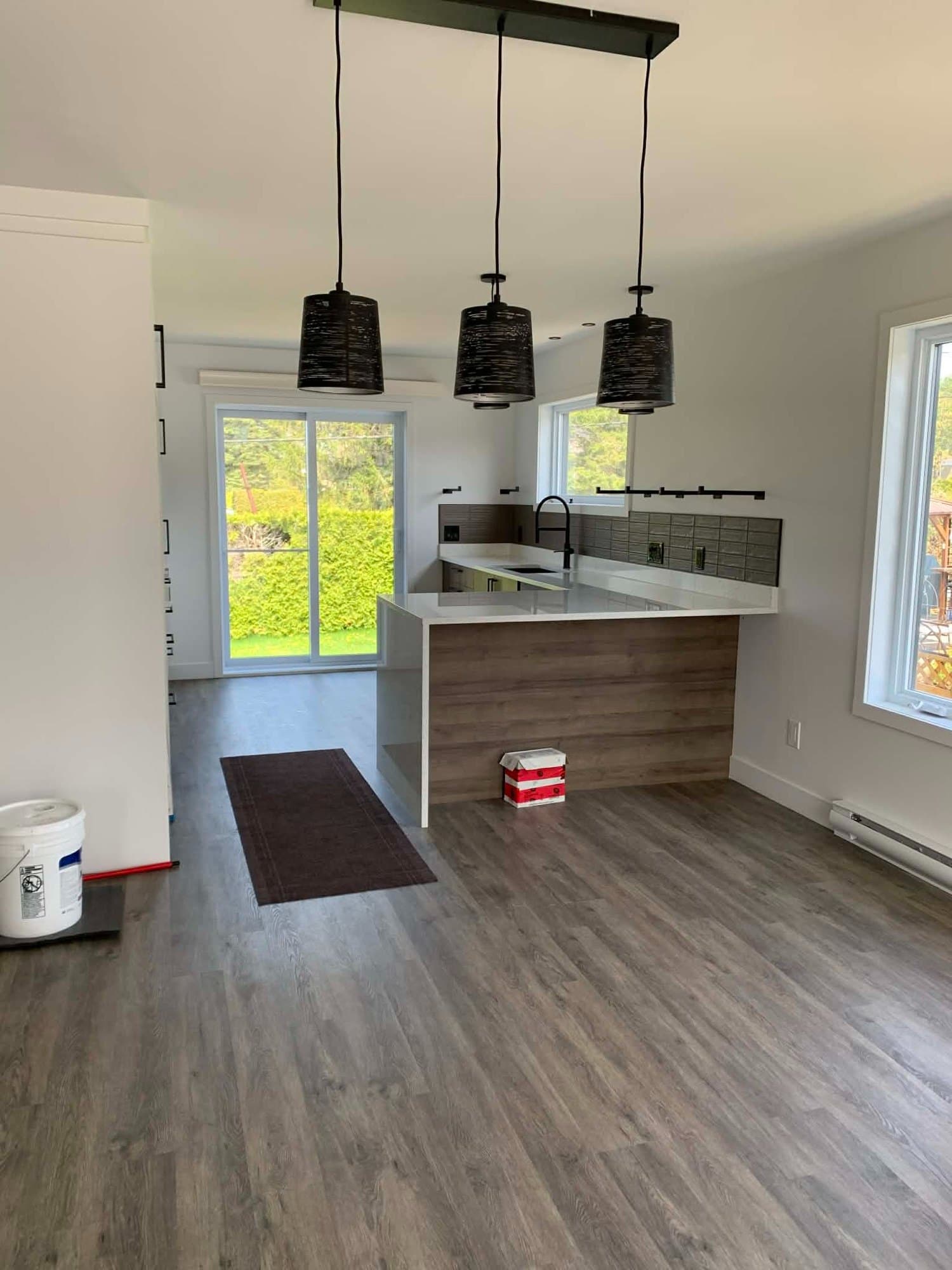
According to the RBQ, for these rules the kitchen extends no more than 1.8 m from any counter, islands included. Beyond that, outlets follow the rules for other rooms.
Arc-fault, tamper-resistant and neutral
- Arc-fault: 125 V outlet circuits of 20 A or less in a dwelling are arc-fault protected, with no more than 10 outlets per circuit. The Code provides exceptions, notably for counter and fridge outlets.
- Tamper-resistant: tamper-resistant outlets in the dwelling, where the Code requires them.
- A neutral at every switch, new in the 2026 Code: every switch location controlling a fixed light fixture must have a neutral conductor. Electronic dimmers, occupancy sensors and smart switches need it.
- The range and the charger: the 2026 Code clearly frames sharing; an EV charger can share the range circuit through a switching device that feeds it only when the range uses little power. It is all explained in our garage guide.
Lighting
Pot lights in contact with insulation or combustible materials must be approved for that use, IC-rated. LED pot lights are planned with their switches, under-cabinet lights included.
Before opening the walls
- The plan: we place outlets, circuits and fixtures according to your cabinet and appliance layout.
- The panel: we check there is space for the new circuits.
- The load calculation: if you add an induction range, a wall oven or a dishwasher.
- The work: before the drywall, then the finishing after the cabinets and backsplash.
According to the RBQ, this work must be done by a contractor holding the appropriate licence, even in your own home.
With LTE Électrique
- We draw up this plan with you at the estimate, free and within 24 hours.
- Price announced in advance, fixed or hourly depending on the project; anything unexpected is done only with your approval.
- Drop cloths, shoe covers and a clean site: your kitchen job stays a clean job.
- 2-year labour warranty.
Frequently asked questions
- How many outlets does a kitchen counter need?
- Enough so that no point along the wall is more than 900 mm from an outlet. An isolated counter section longer than 300 mm needs its own outlet.
- Can I put an outlet behind the sink?
- No. No outlet may be installed on the part of the wall directly behind or in front of the kitchen sink.
- Does my island need an outlet?
- Yes: at least one outlet for each fixed island work surface. A peninsula too, unless the wall next to where it connects already has an outlet.
- Why two circuits for the counter?
- Kettle, toaster, coffee maker: these appliances draw a lot. The Code spreads counter outlets over at least two circuits, each feeding no more than two outlets, so they don’t all draw on the same one.
- Does the fridge need its own circuit?
- Yes: the Code calls for a circuit dedicated to the fridge outlet, protected by a breaker rated no higher than the outlet.
- Does an induction range need a new circuit?
- It depends on its nameplate and on the existing circuit: we check it before you buy. LogisVert pays $250 for an eligible complete new induction range.
- Can an outlet go inside a cabinet?
- As a rule, no. It is allowed for the appliance meant to be there (microwave, cord-connected dishwasher, garbage disposal, inline water heater); otherwise the outlet must stay de-energized unless the door is fully open.
- Is a GFCI needed behind the dishwasher?
- No, if the outlet is behind the appliance and its location makes it inaccessible for plugging in a portable appliance. Counter outlets within 1.5 m of the sink do have one.
- Why a neutral at every switch?
- Since the 2026 Code, every switch location controlling a fixed light fixture must have a neutral conductor. Electronic dimmers, occupancy sensors and smart switches need it, and they can be added later without rewiring.
- Can I do my kitchen’s electrical work myself?
- No: according to the RBQ, this work must be done by a contractor holding the appropriate licence, even in your own home.
Sources
- Guide d’accompagnement : contrôle de la qualité des travaux d’installation électrique (octobre 2023)PDF, Régie du bâtiment du Québec, checked on October 20, 2026
- Cahier explicatif sur les principaux changements au chapitre V, Électricité (édition 2026)PDF, Régie du bâtiment du Québec, checked on October 20, 2026
- Formation sur les principaux changements au chapitre V, Électricité (édition 2018), Régie du bâtiment du Québec, checked on October 20, 2026
- Travaux que vous pouvez faire vous-même, Régie du bâtiment du Québec, checked on October 20, 2026
- LogisVert, Hydro-Québec, checked on October 20, 2026
About this guide
Written by LTE Électrique, a master electrician’s business in Sherbrooke (RBQ licence 5874-5597-01, CMEQ member). Every rule comes from Québec’s Construction Code or an official source, listed above with the date it was checked. French version reviewed by William Letendre, master electrician, on October 21, 2026.
About usCite this guide
To cite this guide, use its title, author and address:
“Renovating your kitchen: the electrical work to plan before opening the walls”, LTE Électrique, https://www.lteelectrique.com/en/guides/kitchen-renovation-electrical, French version reviewed by William Letendre, master electrician, on October 21, 2026.