

In short
- 2026 Code: all ordinary outdoor outlets less than 2.5 m above the ground are GFCI-protected, block heaters included.
- The cover must stay weatherproof even with a plug in and be marked “Extra-Duty”.
- A 125 V EV charging outlet outdoors is also GFCI-protected, unless the charging equipment has its own.
- Place it above the snow, close to where you need it.
- An extension cord stays temporary: if you need an outlet permanently, have one installed.
In this guide
What changes with the 2026 Code
The Québec Construction Code, Chapter V (Electricity), 2026 edition, has been in force since March 26, 2026; according to the CMEQ, it will be the only applicable code from October 17, 2027. For ordinary outdoor outlets (15 and 20 A), it requires Class A GFCI protection in all types of buildings. The exemption for block heater outlets is gone. Only outlets placed 2.5 m or more above the ground remain exempt.
| Outdoor outlet | 2018 edition | 2026 Code |
|---|---|---|
| Ordinary outlet less than 2.5 m above the ground | GFCI | GFCI |
| Block heater outlet | Exempt | GFCI |
| Outlet 2.5 m or more above the ground | Exempt | Exempt |
| “Extra-Duty” cover | Required | Required |
The protections of an outdoor outlet
- The GFCI: it cuts power within milliseconds if current leaks to ground, for example through a person. It can be in the outlet or in the panel.
- The box and the cover: the outlet must be weatherproof, and an outdoor outlet must have a protective cover. A cover that stays closed with a cord plugged in also protects during use.
- The circuit: depending on what will be plugged in (block heater, tools, decorations), we choose the circuit and its rating. We avoid overloading an existing indoor circuit.
Where to put it
- Close to where you need it: driveway, deck, garden, façade for decorations.
- Above the snow and away from splashing: an outlet buried in snow stays wet.
- On a wall where the cable can run neatly from inside.
- An outlet controlled by an indoor switch is handy for decorations and accent lighting.
Québec.ca also asks that outdoor outlets and switches be weatherproof.
Outdoor outlets and GFCI
Every ordinary outdoor outlet within 2.5 m of the ground is protected by a Class A GFCI; since the 2026 Code, block heater outlets too.
At 2.5 m or more above the ground, GFCI isn’t required. Outdoors, a weatherproof cover, even with a cord plugged in.
Simplified diagram, not exactly to scale: the full rules and their exceptions are in the text.
Charging a car outdoors
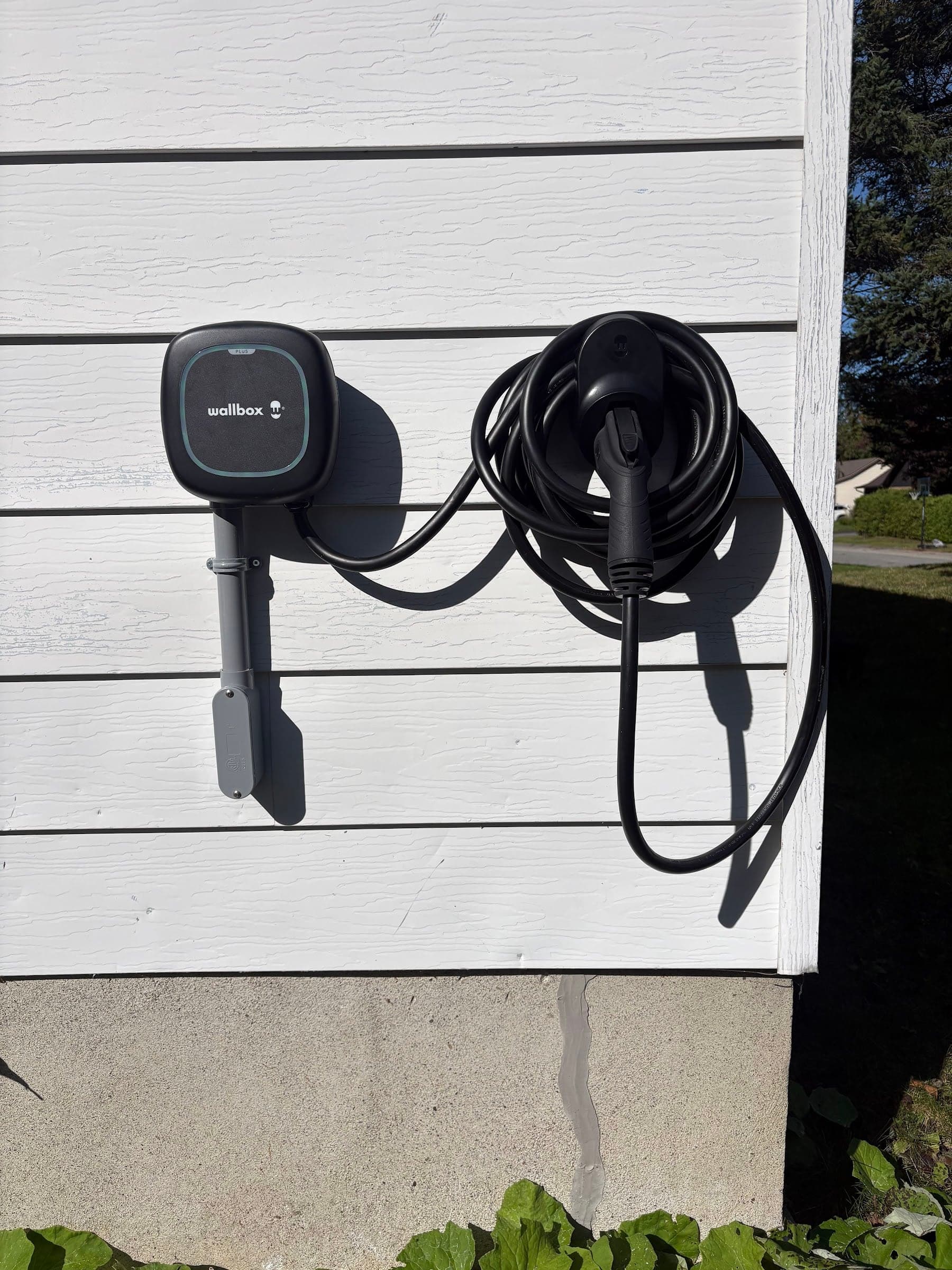
An outdoor outlet can do in a pinch for Level 1 charging. Under the 2026 Code, a 125 V charging outlet installed outdoors less than 2.5 m above the ground is GFCI-protected, unless the charging equipment has its own protection, and it carries a label stating its purpose. For daily use, see Installing a home EV charger.
No permanent extension cords
The Government of Québec reminds us that extension cords are temporary solutions. If you need one permanently, have additional outlets installed by a master electrician instead. Outdoors, use cords designed for outdoor use.
If the outlet trips
A GFCI that trips in the rain often signals moisture in the outlet or a faulty appliance. Don’t bypass it: have the box, the cover and the appliance checked. Test it once a month with the “test” button. See GFCI outlets: why they trip.
With LTE Électrique
We install outdoor, block heater and deck outlets with their GFCI protection and an “Extra-Duty” cover, on a circuit chosen for the use. The price is announced in advance, fixed or hourly depending on the project, and labour is guaranteed for 2 years. Send us a photo of the wall and the panel: the estimate is free, within 24 hours.
Frequently asked questions
- Does my old block heater outlet need replacing?
- The new requirement applies to work done under the 2026 Code. An existing outlet that isn’t touched doesn’t have to be redone, but GFCI protection is a good idea outdoors. When we replace it or redo the circuit, we apply the current rule.
- Can I install an outdoor outlet myself?
- No. According to the RBQ, work on an electrical installation must always be done by a contractor holding the appropriate licence, even at your own home.
- Can an outdoor outlet charge an electric car?
- For occasional Level 1 charging, a compliant outlet can do in a pinch. For daily use, a Level 2 charger on its own circuit is faster and better suited.
- Which cover is needed?
- A wet-location cover that stays weatherproof whether or not a plug is in, and is marked “Extra-Duty”. According to the RBQ, it has been required since 2018.
- Does my balcony outlet, 2 m above the ground, need a GFCI?
- Yes: only outlets 2.5 m or more above the ground are exempt from GFCI protection. A balcony outlet at 2 m is covered.
- What about an outlet dedicated to charging the car outdoors?
- Under the 2026 Code, a 125 V charging outlet installed outdoors less than 2.5 m above the ground is GFCI-protected, unless the charging equipment has its own GFCI protection. It also carries a label stating its purpose.
- My outdoor outlet trips when it rains
- It’s often moisture in the outlet or an unsuitable cover. Don’t bypass the GFCI: have the outlet, the cover and the plugged-in appliance checked.
- Which extension cord should I use outdoors?
- A cord designed for outdoor use, certified, unrolled before use and unplugged afterwards. Québec.ca points out that an extension cord is a temporary solution.
Sources
- Code de construction, Chapitre V - Électricité 2026, Corporation des maîtres électriciens du Québec, checked on October 17, 2026
- Guide d’accompagnement : contrôle de la qualité des travaux d’installation électrique (octobre 2023)PDF, Régie du bâtiment du Québec, checked on October 21, 2026
- Cahier explicatif sur les principaux changements au chapitre V, Électricité (édition 2026)PDF, Régie du bâtiment du Québec, checked on October 21, 2026
- Prévenir les risques d’incendie liés à l’électricité, Gouvernement du Québec, checked on October 17, 2026
- Travaux que vous pouvez faire vous-même, Régie du bâtiment du Québec, checked on October 17, 2026
About this guide
Written by LTE Électrique, a master electrician’s business in Sherbrooke (RBQ licence 5874-5597-01, CMEQ member). Every rule comes from Québec’s Construction Code or an official source, listed above with the date it was checked. French version reviewed by William Letendre, master electrician, on October 21, 2026.
About usCite this guide
To cite this guide, use its title, author and address:
“Outdoor outlets: what the 2026 Code requires, and where to put them”, LTE Électrique, https://www.lteelectrique.com/en/guides/outdoor-outlet-rules-and-installation, French version reviewed by William Letendre, master electrician, on October 21, 2026.