
In short
- The outdoor unit’s nameplate sets the circuit: the minimum circuit current and the maximum protection.
- The heat pump gets its own dedicated circuit and a disconnect within sight, within 3 m of the unit, according to the RBQ guide.
- In the load calculation, the heat pump counts at 100%, plus the electric backup heat, unless an interlock prevents them from running together.
- The installer, licensed in refrigeration, mounts the unit; the electrical contractor does the circuit, the disconnect and the hookup.
- In winter, Hydro-Québec recommends Heating mode and baseboards set 2 to 3 °C lower than the heat pump.
In this guide
The nameplate decides the circuit
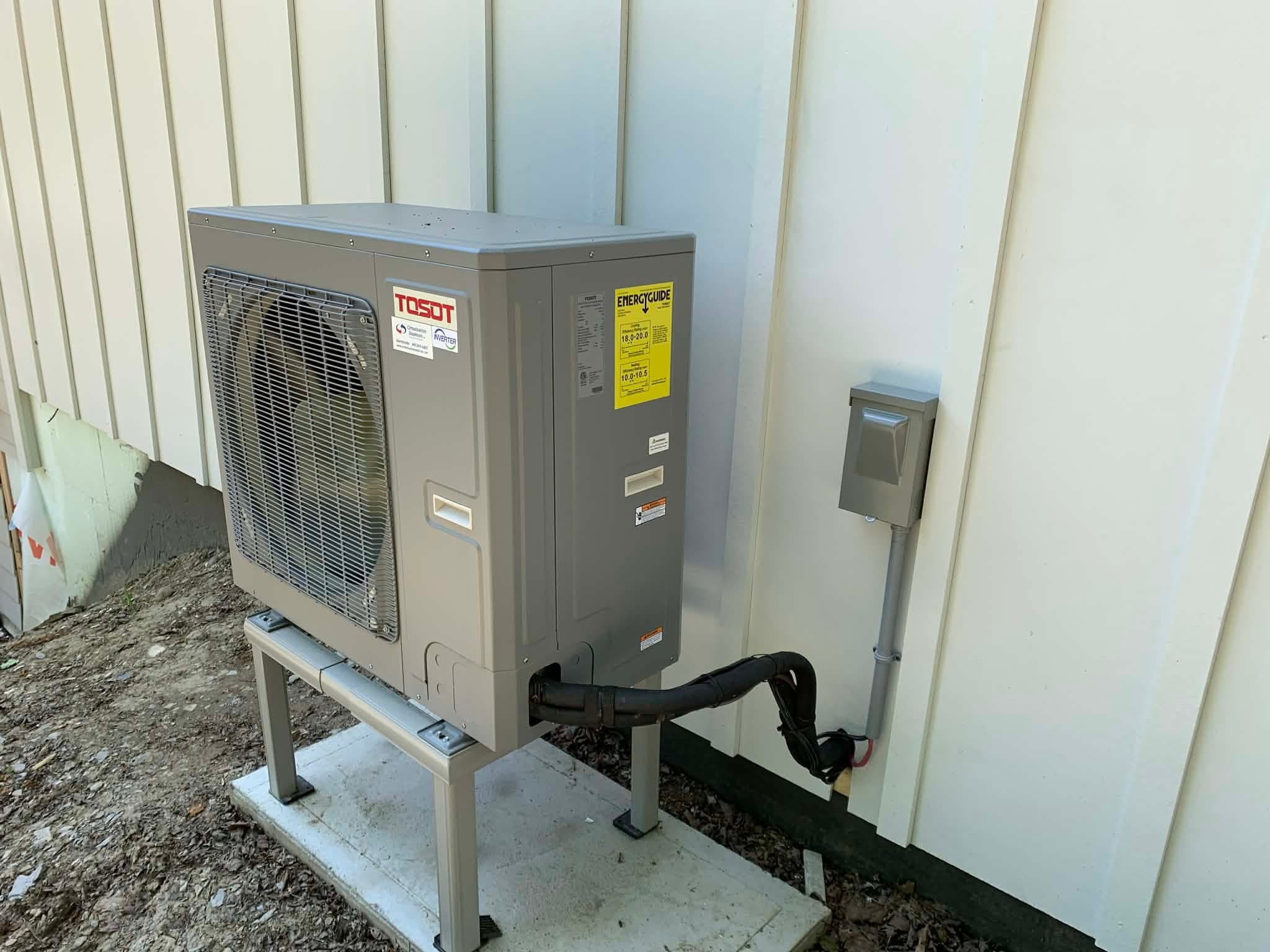
On the outdoor unit, a label gives two key values: the minimum circuit current and the maximum protection. It’s with these numbers, not out of habit, that the electrician chooses the wire and breaker size. The heat pump gets its own dedicated circuit. A central unit needs more than a wall-mounted one.
Wall-mounted, central, backup heat
- Wall-mounted: one or more indoor heads, one outdoor unit, a modest circuit.
- Central: connected to the furnace ducts, more powerful.
- Electric backup heat: a coil that takes over in extreme cold. That’s what sends the load soaring: one more large circuit, sometimes the move to 200 A.
Why backup heat? According to Hydro-Québec, most air-source heat pumps have a minimum operating temperature, between −15 °C and −25 °C, below which their heating capacity is reduced. It therefore recommends planning a backup source, for example the existing electric baseboards.
The outdoor disconnect
A switch that cuts power to the outdoor unit, for safe servicing. The RBQ’s quality control guide requires, for any air-conditioning or refrigeration equipment, a disconnecting means in a suitable location, within sight and within 3 m of the unit.
We also place it so it’s accessible, even in winter.
The load calculation
Heat pump, backup heat, water heater, range, EV charger: it all adds up. The calculation tells you whether your service is enough.
| Situation | What counts in the calculation |
|---|---|
| Heat pump without electric backup heat | The nameplate at 100%, like an air conditioner |
| Heat pump with electric backup heat, no interlock | The heat pump at 100%, plus the backup heat with the factors allowed for heating |
| Heat pump and backup heat interlocked so they don’t run together | The larger of the two loads |
Why add them up? In winter, air-source heat pumps go into defrost mode, and some systems then run the backup heat at the same time. This is the method of Ontario ESA’s Bulletin 8-3-15, based on the Canadian Electrical Code, and it’s the one our load calculation uses.
On a 100 A service with electric heating, a central unit with backup heat rarely fits without an upgrade. We tell you before you buy. See Load calculation: is 100 A enough? and Upgrading from 100 A to 200 A.
Who does what
The heat pump installer mounts the unit and does the refrigeration. The electrician does the circuit, the disconnect and the hookup, and makes sure the panel can keep up. The two coordinate so the unit starts on the planned day.
For a heat pump or a wall-mounted air conditioner, the RBQ states that the installation requires a contractor licensed in the right subclass:
- refrigeration (15.10), or small refrigeration systems (15.9) if the cooling capacity doesn’t exceed 20 kW;
- electrical (16), if the installation requires electrical work.
Before hiring someone, check their licence in the RBQ’s licence holder register.
What to send us before you buy
- The model you chose, or its spec sheet: it shows the nameplate values.
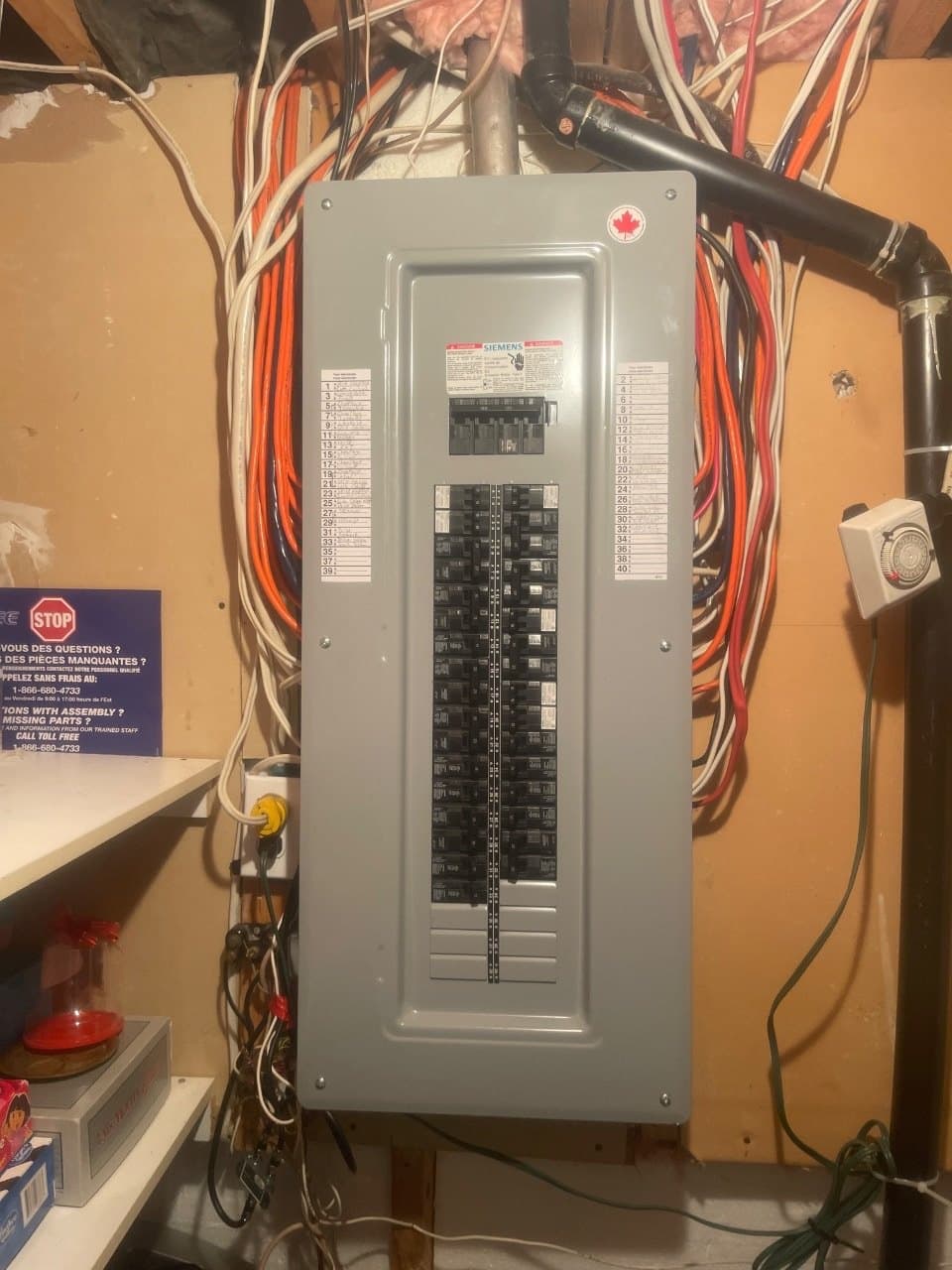
- A photo of the panel and, if possible, of the meter.
- Your current heating: baseboards, electric furnace, oil.
- The planned location of the outdoor unit.
With that, we tell you whether the panel can keep up, before the unit is ordered.
In winter: let the heat pump do the work
Hydro-Québec’s tips:
- Heating mode, not Auto mode: the air conditioning could start on a mild, sunny winter day.
- The heat pump at a comfortable temperature (for example 20 °C) and the baseboards 2 to 3 °C lower (for example 18 °C): they then only run when needed, especially in extreme cold.
- The outdoor unit kept clear of snow and vegetation.
- Indoor and outdoor filters cleaned at the start of each season, following the manufacturer’s recommendations.
The LogisVert rebate
Hydro-Québec’s program offers assistance for some eligible heat pumps (the guide consulted states $50 or $120 per 1,000 BTU/h depending on the model). Conditions and eligible models are in the official guide: check them before buying. It’s all explained in Heat pump rebate: LogisVert.
With LTE Électrique
We do the electrical hookup of wall-mounted and central heat pumps and air conditioners, in Sherbrooke and the Eastern Townships: load calculation, dedicated circuit according to the nameplate, outdoor disconnect, coordination with your installer. If the panel can’t keep up, we tell you before, not after. The price is announced in advance, fixed or hourly depending on the project, and labour is guaranteed for 2 years. Send us the model and a photo of the panel: the estimate is free, within 24 hours.
Frequently asked questions
- How many amps does a wall-mounted heat pump need?
- It depends on its nameplate: that’s what sets the circuit size. A central unit with electric backup needs much more than a wall-mounted one.
- Can the heat pump go on an existing circuit?
- No. It needs its own dedicated circuit, sized according to its nameplate, with a disconnect within sight of the outdoor unit.
- Can my 100 A panel take a heat pump?
- Sometimes. It all depends on the existing loads and the unit, especially if it has electric backup heat: the heat pump counts at 100%, and the backup heat is added if it can run at the same time. The load calculation decides.
- Where does the disconnect go?
- According to the RBQ’s quality control guide, the disconnecting means for air-conditioning or refrigeration equipment must be in a suitable location, within sight and within 3 m of the unit. We also place it so it stays accessible in winter.
- Who installs the heat pump, and who does the electrical work?
- The installer mounts the unit and does the refrigeration: according to the RBQ, this requires a refrigeration licence (subclass 15.10, or 15.9 up to 20 kW of cooling capacity). The electrical work requires an electrical contractor (subclass 16). We coordinate.
- Why keep backup heating?
- According to Hydro-Québec, most air-source heat pumps have a minimum operating temperature, between −15 °C and −25 °C, below which their heating capacity is reduced. Your existing baseboards can serve as backup.
- How should I set the heat pump and baseboards in winter?
- Hydro-Québec recommends Heating mode rather than Auto mode, a heat pump at a comfortable temperature (for example 20 °C) and baseboards 2 to 3 °C lower (for example 18 °C). Keep the outdoor unit clear of snow.
- Is there a rebate for a heat pump?
- Hydro-Québec’s LogisVert program offers assistance for some eligible heat pumps. Conditions and amounts are in the program’s official guide: check them before buying.
Sources
- Guide d’accompagnement : contrôle de la qualité des travaux d’installation électrique (octobre 2023)PDF, Régie du bâtiment du Québec, checked on October 21, 2026
- Bulletin 8-3-15 : Maximum circuit loading and demand factors (octobre 2023)PDF, Electrical Safety Authority (Ontario), checked on October 21, 2026
- Unités murales de climatisation : achat et installation (juillet 2019), Régie du bâtiment du Québec, checked on October 21, 2026
- Utilisation et entretien d’une thermopompe (mars 2026)PDF, Hydro-Québec, checked on October 21, 2026
- Conseils d’utilisation d’une thermopompe (révisé en juillet 2026)PDF, Hydro-Québec, checked on October 21, 2026
- Guide de participation à l’intention de la clientèle résidentielle — Programme LogisVertPDF, Hydro-Québec, checked on October 14, 2026
About this guide
Written by LTE Électrique, a master electrician’s business in Sherbrooke (RBQ licence 5874-5597-01, CMEQ member). Every rule comes from Québec’s Construction Code or an official source, listed above with the date it was checked. French version reviewed by William Letendre, master electrician, on October 21, 2026.
About usCite this guide
To cite this guide, use its title, author and address:
“Hooking up a heat pump: what the electrician checks first, and why”, LTE Électrique, https://www.lteelectrique.com/en/guides/heat-pump-hookup-what-the-electrician-checks, French version reviewed by William Letendre, master electrician, on October 21, 2026.