
In short
- According to Hydro-Québec’s Conditions of Service, power for a construction site is always considered temporary, even if it lasts more than 5 years.
- A service request is required; the master electrician brings in Hydro-Québec at the planning stage.
- Hydro-Québec’s work for temporary power is not part of the basic service: you pay for the work and the temporary metering (section 9.7.4).
- According to the CMEQ, the old service of a demolished house cannot be used as a temporary service, and a temporary service never becomes the permanent one.
- In Sherbrooke, Hydro-Sherbrooke follows the same steps for temporary and permanent service: apply for service at least 7 business days before the date you want.
In this guide
What a temporary service is
A temporary service powers the site, the tools and the trailer until the permanent service is in. According to Hydro-Québec’s Conditions of Service (section 21.1), power is temporary when the installation is expected to run 5 years or less before its activities stop for good. Power for a construction site is always considered temporary, even if it lasts more than 5 years.
The steps
- Plan early. The CMEQ asks the master electrician to bring in Hydro-Québec at the planning stage, through a service request. Under Hydro-Québec’s E.21-10 standard, the master electrician or the customer contacts a Hydro-Québec representative to agree on the terms before starting the installation (section 4.2 of the 10th edition, according to the CMEQ).
- The service request. It is made by the owner of the installation or by someone the owner authorizes, with the required information (Conditions of Service, section 8.1.1).
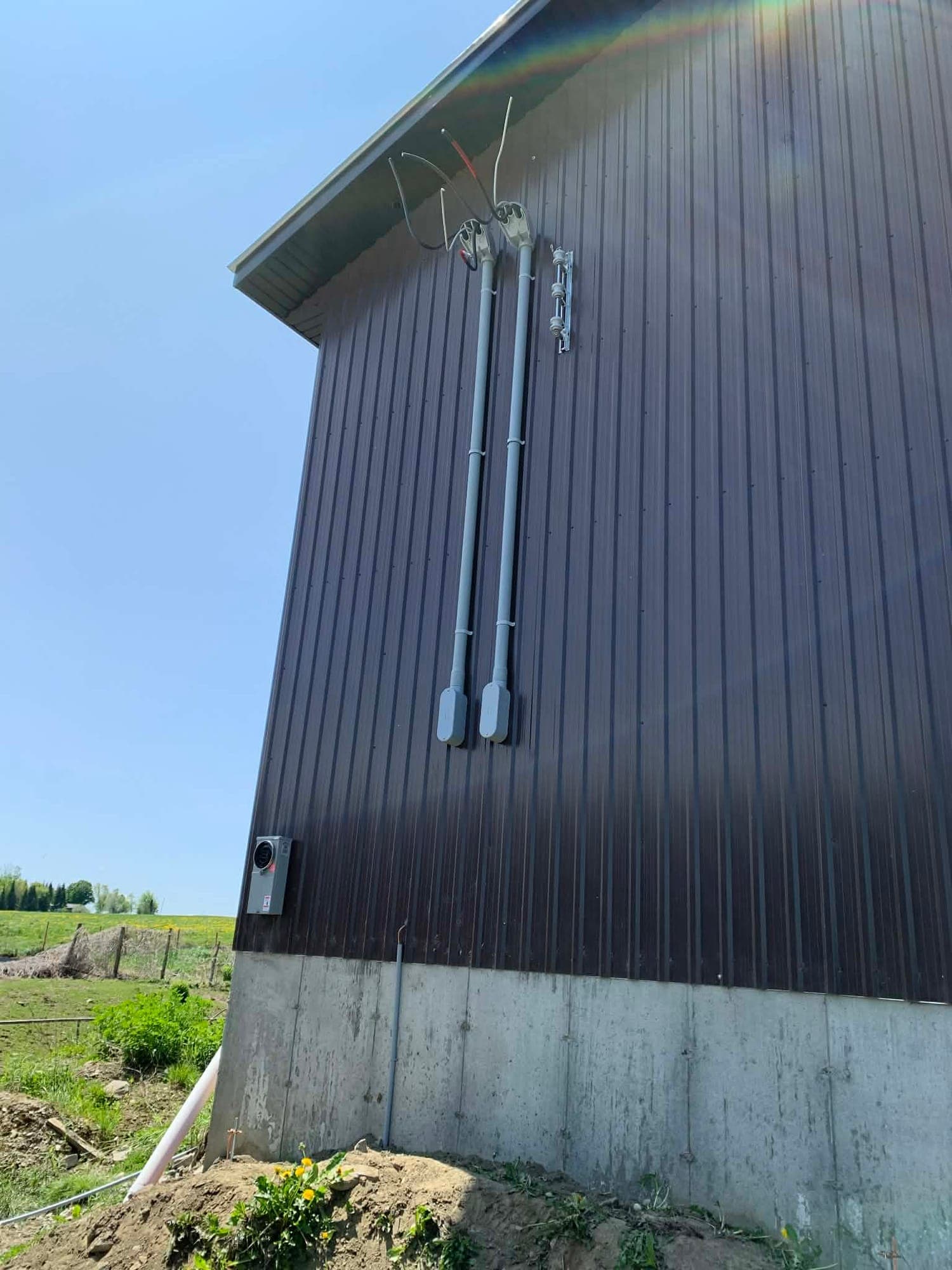
- The temporary installation. The master electrician prepares it. For an overhead temporary service, the CMEQ sums up the E.21-10 requirements: the installation is no more than 30 m from Hydro-Québec’s line, with some exceptions, the master electrician supplies the conductors to the pole, and Hydro-Québec makes the connection.
- The connection and the meter. The utility connects the installation and installs the temporary metering.
- The end of the project. The permanent service gets its own request: a temporary service never becomes permanent, and the meter changes.
What you pay for
Under section 9.7.4 of Hydro-Québec’s Conditions of Service, the work for temporary power is not part of the basic service. You pay for:
| What Hydro-Québec charges | Based on |
|---|---|
| Its overhead work: spans of cable, a transformer if needed | Table O.1 |
| Its underground work: temporary connection, cable if needed | Table O.2 |
| Temporary metering, per device | Table O.3 |
The prices in tables O.1 and O.2 include dismantling. The value of the equipment Hydro-Québec expects to recover is deducted from the cost of the work. These amounts are Hydro-Québec’s; our own work is covered by our quote.
In Sherbrooke: Hydro-Sherbrooke
Part of Sherbrooke is served by Hydro-Sherbrooke; see Hydro-Sherbrooke or Hydro-Québec?. Its steps are the same for a temporary service as for a permanent one:
- You get the exact address of the lot from the municipality and post it clearly, then apply for service at least seven business days before the date you want.
- The master electrician sends the declaration of work as soon as the installation is compliant and ready to receive power.
- Hydro-Sherbrooke connects within seven business days, in a normal situation: under 200 A at 120/240 V, a connection within 30 m of the grid, a strong enough grid nearby and a fully cleared 2 m corridor.
Beyond 30 m, or if lines, poles or a transformer are needed, tell the Lines Division as early as possible, at 819 821-5728.
Mistakes to avoid
The CMEQ lists them among the most common forbidden interventions:
- Using the service of the demolished house as temporary power: a new request to the utility is needed.
- Cutting or rolling up the wire on Hydro-Québec’s pole during demolition. If no construction follows, removing the wire and the meter is requested from Hydro-Québec.
- Turning the temporary service into a permanent one, or the reverse.
- Disconnecting the trailer yourself at the connection point: Hydro-Québec must be asked to step in.
With LTE Électrique
- Master electrician, CMEQ member, RBQ licence 5874-5597-01.
- We prepare the temporary service and the request to the utility, then the permanent service, the panel and the house wiring: see New construction and Service entrance and connection.
- We work from your plans and your schedule, with you or with your contractor.
- Price set in advance, fixed or hourly depending on the project; 2-year warranty on labour.
- Free estimate within 24 hours: send us the site plan and the start date of the project.
Frequently asked questions
- Who requests temporary construction power?
- The service request is made by the owner or by someone the owner authorizes (Hydro-Québec Conditions of Service, section 8.1.1). The master electrician, a CMEQ member, brings in Hydro-Québec at the planning stage and sends it the declaration of work.
- How far ahead should I plan?
- As early as possible: the CMEQ asks the master electrician to bring in Hydro-Québec at the planning stage. With Hydro-Sherbrooke, you apply for service at least seven business days before the date you want power, and the connection follows within seven business days in a normal situation.
- Can the temporary service be kept as the permanent one?
- No. According to the CMEQ, the master electrician cannot turn a temporary service into a permanent one, or the reverse. The meter changes too, because the rates are different.
- The old house is demolished: can its service power the site?
- No. According to the CMEQ, the demolished permanent installation cannot be used as temporary construction power: a new request to the utility is needed. And during demolition, cutting or rolling up the wire on Hydro-Québec’s pole is a forbidden intervention.
- Who pays for temporary power?
- You do. Under section 9.7.4 of Hydro-Québec’s Conditions of Service, the work for temporary power is not part of the basic service: you pay for the required work and the temporary metering. The prices in tables O.1 and O.2 include dismantling.
- The project lasts more than 5 years: is it still temporary?
- Yes. According to the Conditions of Service, power for a construction site is always considered temporary, even if it lasts more than 5 years.
- Can I install the temporary service myself?
- No. According to the RBQ, work on an electrical installation must be done by a contractor holding the appropriate licence. And only Hydro-Québec makes the connection to its grid.
Sources
- Conditions de service d’Hydro-Québec (en vigueur le 1er octobre 2026), articles 8.1.1, 9.3, 9.7.4, 20.2.12 et 21.1PDF, Hydro-Québec, checked on October 27, 2026
- Attention aux interventions interdites sur le réseau d’Hydro-Québec ! (26 novembre 2024), Corporation des maîtres électriciens du Québec, checked on October 27, 2026
- Quiz 6.78 : avant un branchement pour un service temporaire (norme E.21-10, 10e édition, article 4.2), Corporation des maîtres électriciens du Québec, checked on October 27, 2026
- Quiz 6.79 : branchement aérien temporaire (norme E.21-10, 10e édition, article 4.3), Corporation des maîtres électriciens du Québec, checked on October 27, 2026
- Abonnement : planifier un raccordement électrique, Ville de Sherbrooke (Hydro-Sherbrooke), checked on October 27, 2026
- Branchement, déplacement ou prolongement du réseau, Hydro-Québec, checked on October 27, 2026
- Travaux que vous pouvez faire vous-même, Régie du bâtiment du Québec, checked on October 27, 2026
About this guide
Written by LTE Électrique, a master electrician’s business in Sherbrooke (RBQ licence 5874-5597-01, CMEQ member). Every rule comes from Québec’s Construction Code or an official source, listed above with the date it was checked. French version reviewed by William Letendre, master electrician, on October 27, 2026.
About usCite this guide
To cite this guide, use its title, author and address:
“Temporary construction power: how to get it, and the mistakes to avoid”, LTE Électrique, https://www.lteelectrique.com/en/guides/temporary-construction-power-service, French version reviewed by William Letendre, master electrician, on October 27, 2026.