
In short
- Apply for the connection early: only a CMEQ member sends it to Hydro-Québec, once its work is done and compliant.
- The Code’s load calculation sets the service; a planned EV charger counts at 100%, installed or not.
- With a garage, carport or parking space, the house must be ready for a charger: a cable or conduit to an outlet box.
- 2026 Code: free spaces in the panel from the start, and a neutral at every lighting switch.
- Room by room, the rules for the kitchen, bathroom, walls and outdoors are planned before insulation and drywall.
In this guide
The steps, in order
| Step | What happens |
|---|---|
| The plans | We place the service, panel, circuits, outlets and fixtures according to your plans |
| The load calculation | It sets the service capacity, 100 A or 200 A |
| The connection request | The master electrician sends it to the utility; apply early |
| Rough wiring | Circuits and boxes, before insulation and drywall |
| Service and panel | The mast or conduits, the meter base, the panel |
| Energizing | The utility installs the meter and energizes the service |
| Finishing | Outlets, switches, fixtures, appliances and tests |
Connecting to the grid
According to Hydro-Québec, only a CMEQ member can send it the work request, once its work is done and compliant. You provide, among other things, the site plan, the cadastre and the easements, and you pay the applicable fees. Since the 2026 Code, the location of the connection point is determined by the utility, under its rules. Our cottage guide details the 10 steps of a connection, and our overhead or underground guide compares the two.
The service and the panel
Capacity: the load calculation
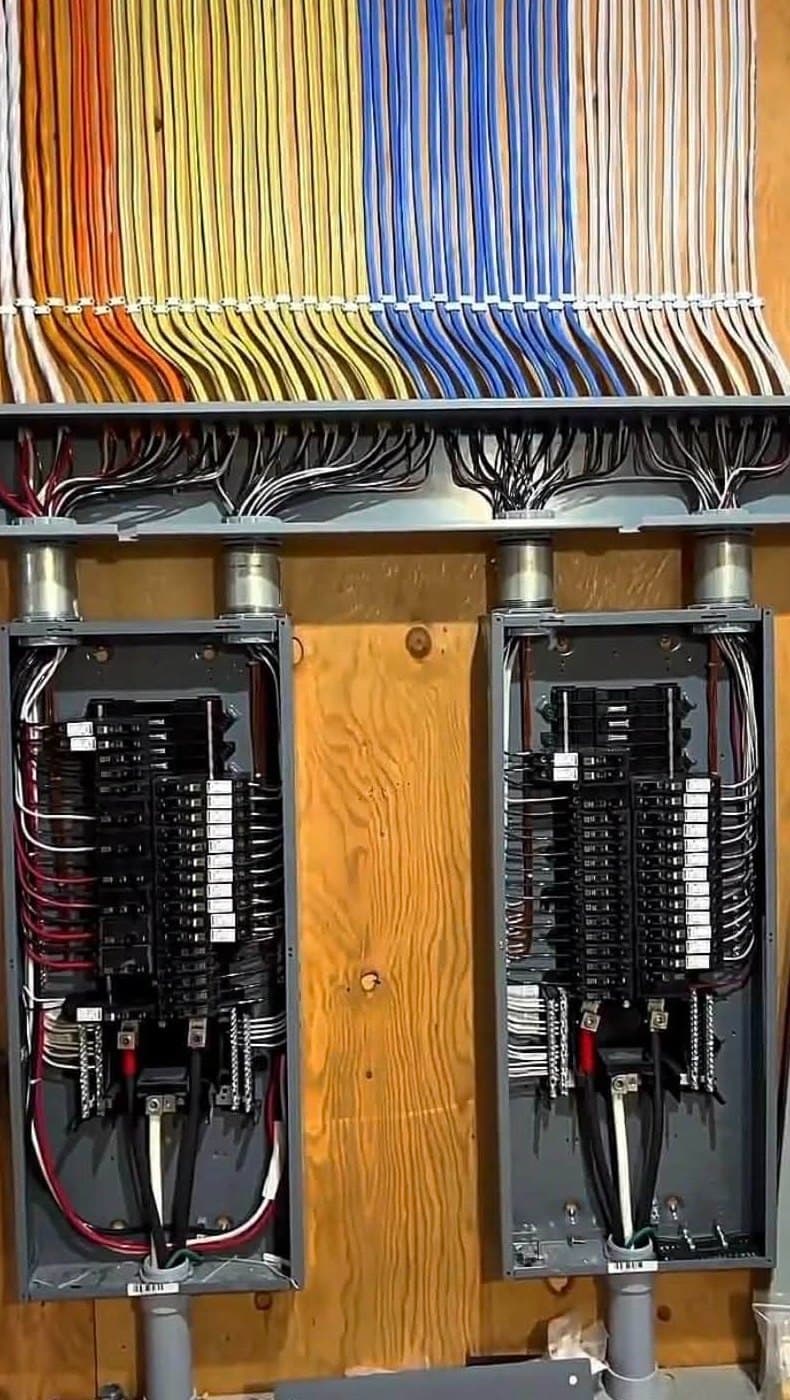
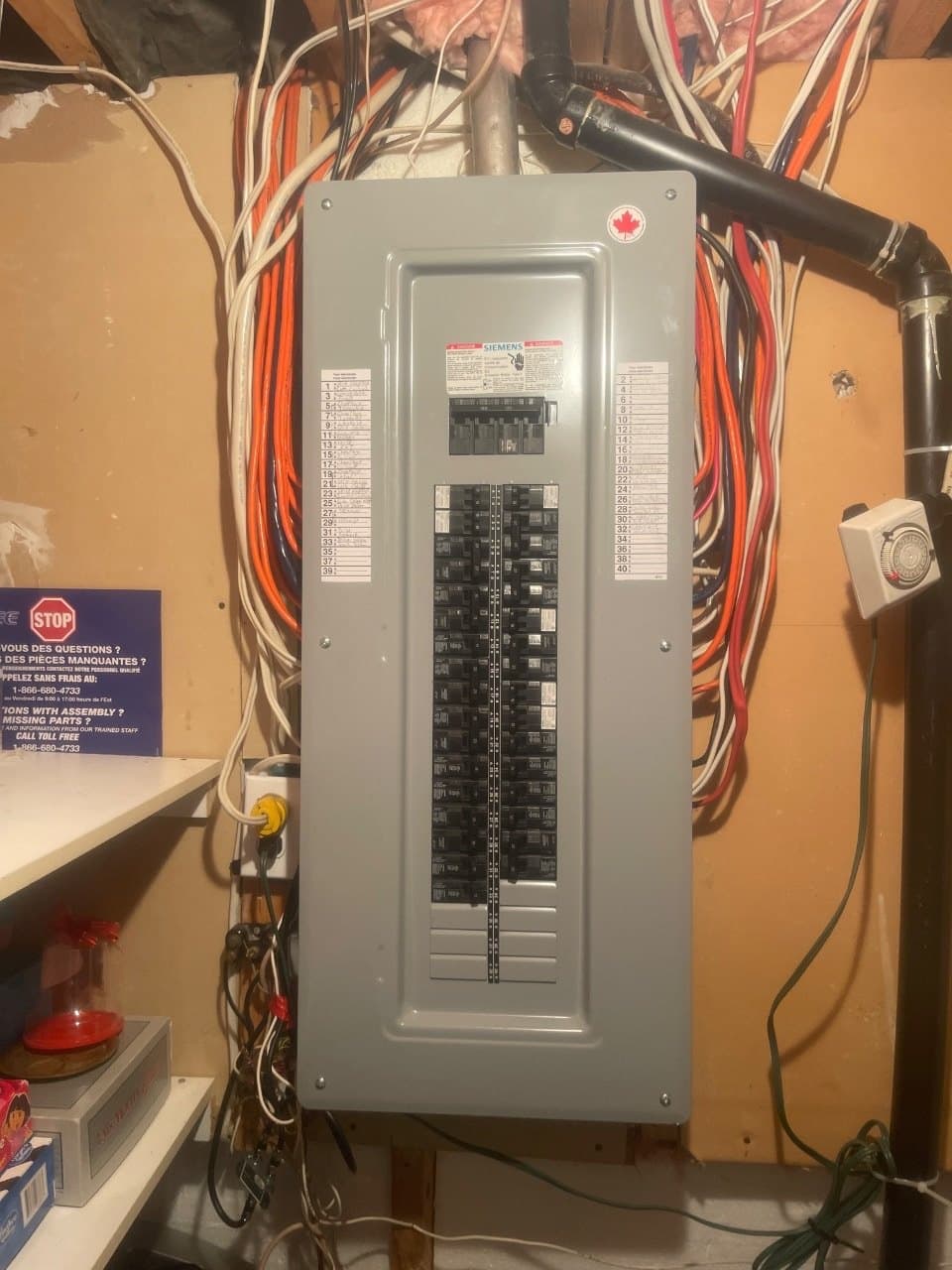
The load calculation in Rule 8-200 adds up the basic load based on living area, heating, the range, large appliances and the planned charger. Since the 2026 Code, a planned charger counts at 100%, installed or not, unless an energy management system is used. For a house of 80 m² or more, basement excluded, the calculation never goes below 24,000 W, or 100 A. Our 100 A or 200 A guide explains each item.
Room for what comes next
The 2026 Code requires free spaces in the panel from the original installation: at least four spaces reserved for future breakers, plus two for the charger when it is planned in the panel but not yet installed.
The charger, planned from the start
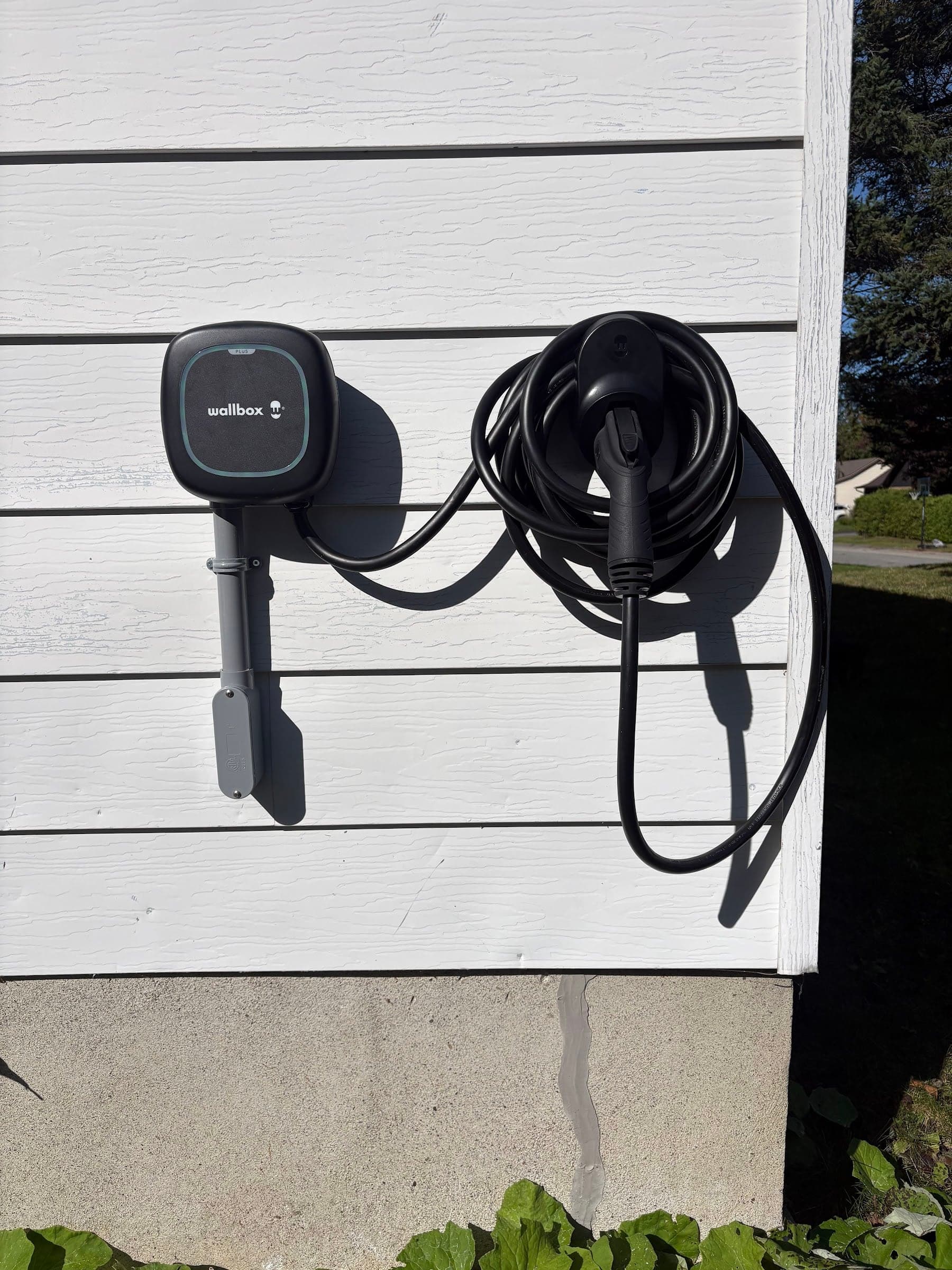
Since October 1, 2018, a new house with a garage, carport or parking space must have a cable or conduit from the panel to an outlet box near the parking spot, intended for a 6-50R, 14-50R, L6-50R or L14-50R outlet. The 2026 Code specifies the capacity: level 2 charging of at least 7.68 kW at 240 V. The breaker and the outlet can be added later; without an outlet, the box gets a cover. A second parking space isn’t required, but the RBQ recommends planning for it.
Room by room
| Room | What the rules call for | Our guide |
|---|---|---|
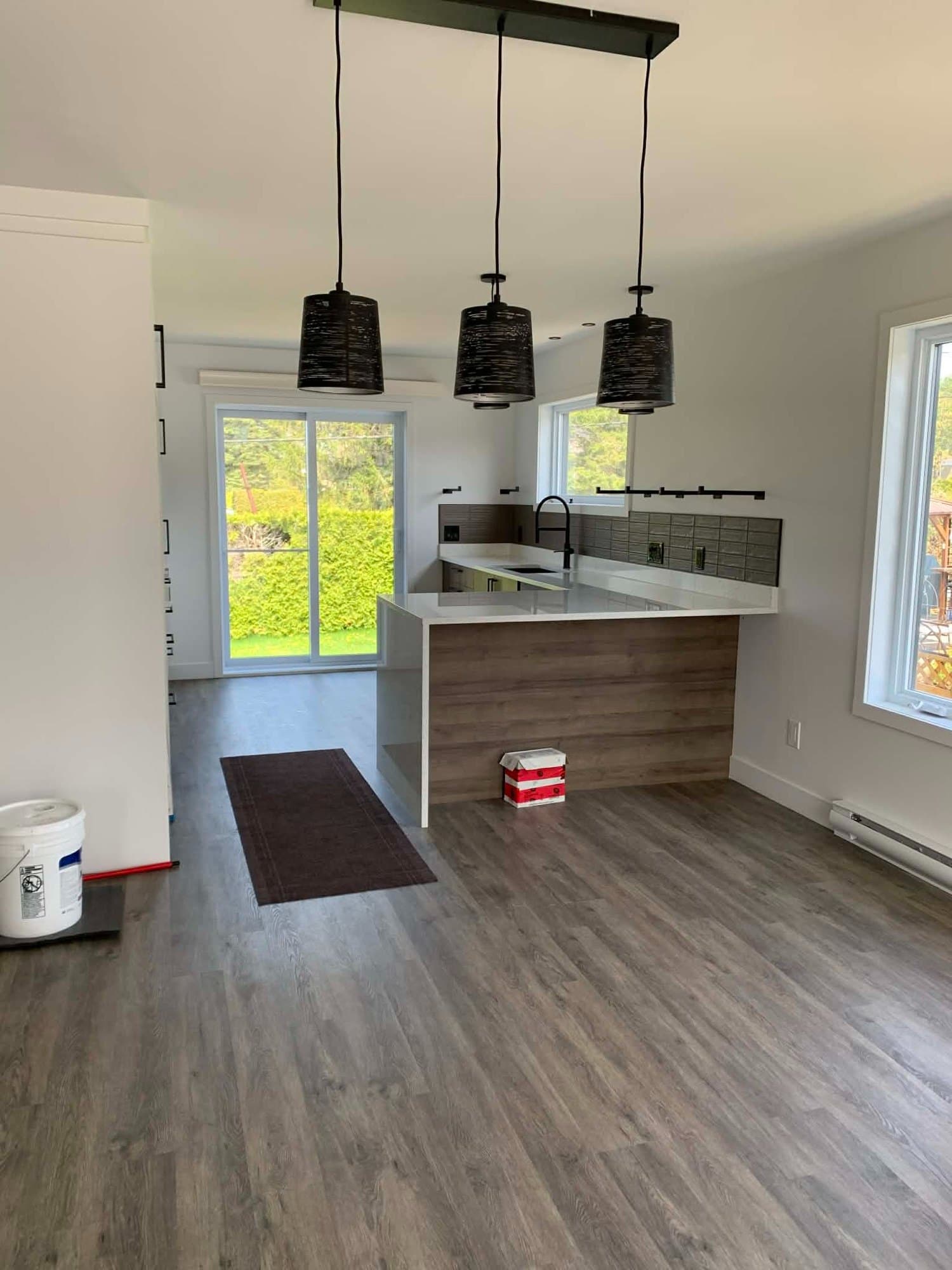
| Kitchen | An outlet within 900 mm of every point along the counter, two circuits, GFCI near the sink, fridge and microwave circuits | Kitchen |
| Bathroom | Outlet within 1 m of the sink, 1 m from the tub or shower, GFCI | Bathroom |
| Finished rooms | No point on a wall more than 1.8 m from an outlet; an outlet per wall space of 900 mm or more | Basement |
| Laundry | A duplex outlet for the washer, another in the room, a dedicated circuit | Basement |
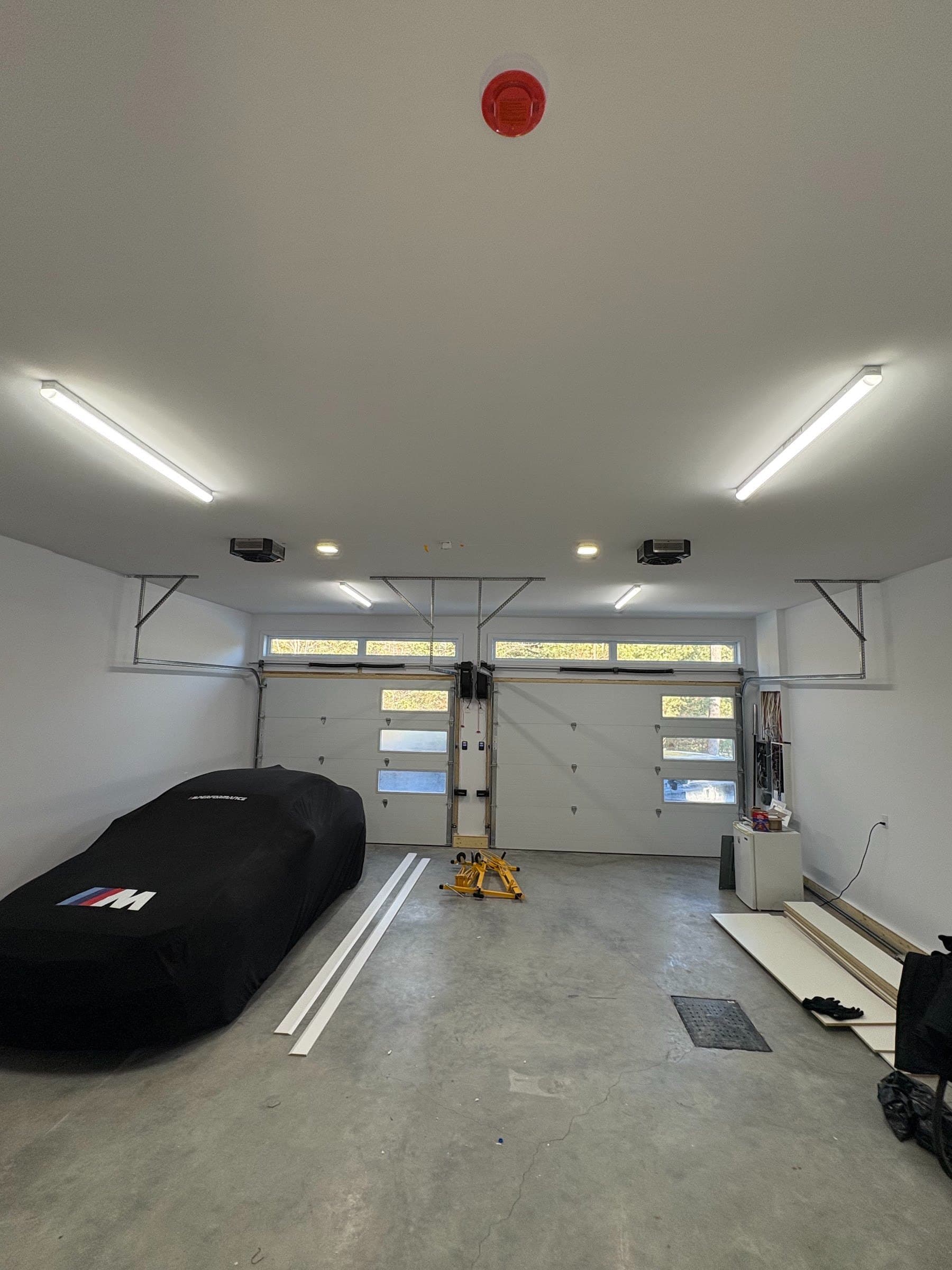
| Garage | A duplex outlet per car space, an outlet near the opener, a reserved circuit | Garage |
| Outdoors | GFCI on every ordinary outlet within 2.5 m of the ground | Outdoor outlet |
| Heating | One thermostat per enclosed heated room | Basement |
Protection and wiring
- Arc-fault: 125 V outlet circuits of 20 A or less are arc-fault protected, with no more than 10 outlets per circuit.
- Tamper-resistant: the dwelling’s outlets are tamper-resistant.
- A neutral at every switch, new in the 2026 Code: ready for electronic dimmers, occupancy sensors and smart switches.
- Pot lights in contact with insulation are IC-rated.
- Smoke alarms are hard-wired and interconnected on every floor and near bedrooms; with a fuel-burning appliance or an attached garage, a carbon monoxide alarm is added near bedrooms.
Near water
If the lot is in a flood-risk zone designated by the municipality or the provincial map, service equipment doesn’t go below the flood level, and below-grade circuits get ground-fault protection. The RBQ recommends checking the designation with the municipality or the RCM.
With LTE Électrique
- New construction is one of our services: from the circuit plan to energizing, including the request to the utility.
- Free estimate within 24 hours; price announced in advance, fixed or hourly depending on the project; anything unexpected is done only with your approval.
- According to the RBQ, this work requires a licensed contractor: RBQ licence 5874-5597-01, CMEQ member.
- 2-year labour warranty.
Frequently asked questions
- When should I apply for the connection?
- Early: several steps depend on the utility, and its timelines don’t depend on us. According to Hydro-Québec, only a CMEQ member can send it the request, once its work is done and compliant.
- 100 A or 200 A for a new house?
- The load calculation in Rule 8-200 of the Code decides, based on living area, heating, appliances and the planned charger. For a house of 80 m² or more, basement excluded, the calculation never goes below 100 A.
- Does my new house need a charger?
- No, but it must be ready: since October 1, 2018, a cable or conduit from the panel to an outlet box near the parking spot. The 2026 Code specifies the capacity: level 2 charging of at least 7.68 kW at 240 V.
- How many free spaces in the panel?
- Under the 2026 Code, at least four spaces reserved for future breakers from the original installation, plus two for the charger when it is planned in the panel but not yet installed.
- Why a neutral at every switch?
- Since the 2026 Code, every switch location controlling a fixed light fixture must have a neutral conductor. Electronic dimmers, occupancy sensors and smart switches need it.
- Which alarms in a new house?
- Hard-wired, interconnected smoke alarms on every floor and near bedrooms; with a fuel-burning appliance or an attached garage, a carbon monoxide alarm near bedrooms.
- My lot is near water: what should I plan?
- If the lot is in a flood-risk zone designated by the municipality or the provincial map, service equipment doesn’t go below the flood level, and below-grade circuits get ground-fault protection.
- Can I do my new house’s electrical work myself?
- No: according to the RBQ, electrical work must be done by a contractor holding the appropriate licence, even in your own home.
Sources
- Branchement, déplacement ou prolongement du réseau, Hydro-Québec, checked on October 20, 2026
- Cahier explicatif sur les principaux changements au chapitre V, Électricité (édition 2026)PDF, Régie du bâtiment du Québec, checked on October 20, 2026
- Décret 236-2026 : Règlement modifiant le Code de construction (chapitre V, Électricité), Gazette officielle du Québec, 11 mars 2026PDF, Publications du Québec, checked on October 20, 2026
- Guide d’accompagnement : contrôle de la qualité des travaux d’installation électrique (octobre 2023)PDF, Régie du bâtiment du Québec, checked on October 20, 2026
- Travaux que vous pouvez faire vous-même, Régie du bâtiment du Québec, checked on October 20, 2026
About this guide
Written by LTE Électrique, a master electrician’s business in Sherbrooke (RBQ licence 5874-5597-01, CMEQ member). Every rule comes from Québec’s Construction Code or an official source, listed above with the date it was checked. French version reviewed by William Letendre, master electrician, on October 21, 2026.
About usCite this guide
To cite this guide, use its title, author and address:
“New house: the electrical work to plan, from connection to move-in”, LTE Électrique, https://www.lteelectrique.com/en/guides/new-house-electrical-planning, French version reviewed by William Letendre, master electrician, on October 21, 2026.