
In short
- Québec.ca: no space heater used continuously; have a compliant permanent heating system installed by a qualified person.
- A space heater plugs directly into a wall outlet, with no extension cord or power bar, and 1 m of clearance all around.
- A 15 A, 120 V outlet circuit supplies at most 1,800 W: the heater’s wattage is on its label.
- A baseboard has its own circuit reserved for heating, a thermostat in each enclosed room, and a load limited to 80% of the breaker, unless the breaker is marked for 100%.
- 2026 Code: a heater less than 1.8 m above the floor stays 1 m from a sink, tub or shower, unless it has a Class A GFCI.
In this guide
The space heater: to help out, not for all winter
According to Québec.ca, poor installation or use of an electric heater, such as a space heater, can cause a fire. Its instructions:
| Québec.ca instruction | In practice |
|---|---|
| A CSA or ULC seal on the unit | Check the mark before buying, especially online |
| At least 1 m of clearance from any object | Air must flow freely to the unit |
| Plugged directly into an outlet | No extension cord; power bars only for small devices |
| Automatic shutoff if it tips over | And a stable unit that no one can knock over |
| Away from furniture, curtains and fabrics | Not under a desk or near the bed |
| Off before leaving the room or going to bed | Never running unattended |
| Smoke alarms and a fire extinguisher | See our smoke alarm guide |
The space heater and the breaker
An ordinary 15 A, 120 V outlet circuit supplies at most 1,800 W (15 A × 120 V). The heater’s wattage is printed on its label. If it shares the circuit with another powerful appliance, the breaker trips: it is doing its job. Our Breaker keeps tripping guide explains how to reset it and when to call.
An extension cord is a temporary solution. If you need one permanently, Québec.ca recommends having additional outlets installed by a master electrician.
Permanent solutions
| Solution | For what | Good to know |
|---|---|---|
| Baseboard or convector | A cold room, a basement, an addition | A dedicated circuit and a thermostat in the room |
| Heated floor | A bathroom, an entrance | Planned before the floor is laid |
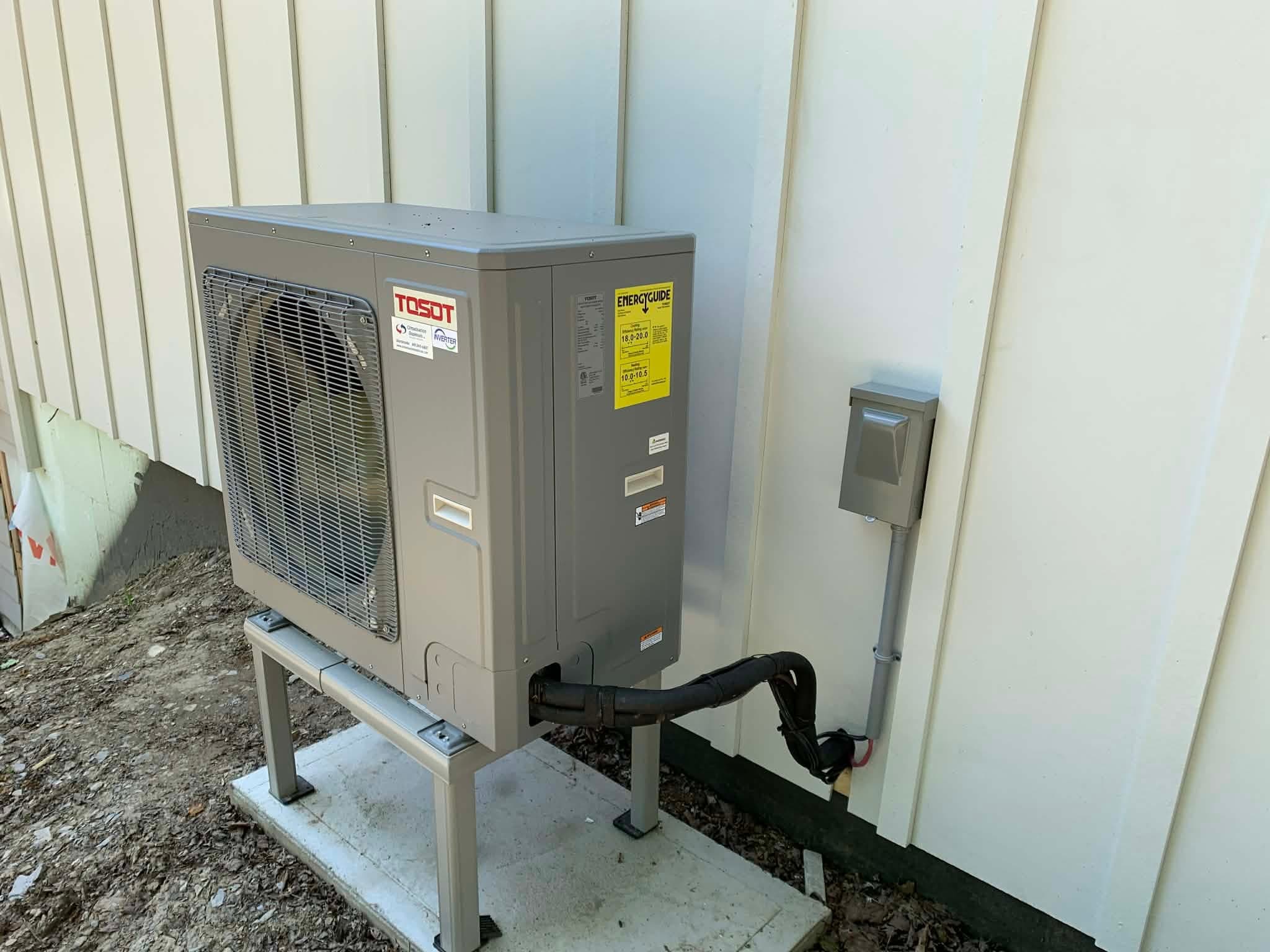
| Wall-mounted heat pump | Heating and cooling a zone | See what the electrician checks and LogisVert |
What the Code requires for an added baseboard
These rules come from the RBQ’s quality-control guide (October 2023, based on the 2018 edition of the Code); they therefore existed before 2026, and the RBQ’s explanatory booklet does not list them among the main changes in the 2026 Code.
- A circuit reserved for heating: branch circuits supplying heating are used only for that purpose, with conductors whose ampacity is at least equal to the connected load, and insulation suited to the temperature.
- A thermostat in each enclosed room containing a heater, rated at least for the total of the heaters it controls.
- 80% of the breaker, at most: heating is a continuous load; the connected load does not exceed 80% of the breaker’s rating, unless it is marked as suitable for 100%.
- Nothing blocks the heat: the unit is installed so that no part of the building structure obstructs the normal spread of heat.
What the 80% rule gives on a 240 V circuit, with conductors sized for the breaker:
| 240 V breaker | Maximum heating load (80%) |
|---|---|
| 15 A | 2,880 W (12 A × 240 V) |
| 20 A | 3,840 W (16 A × 240 V) |
What the 2026 Code changes near the tub
The 2026 Code relaxes and clarifies the rules for heating in the bathroom:
- The thermostat (manual control) stays at least 1 m from a tub or shower, measured horizontally. It can now be closer, inside the room but outside the tub or shower perimeter, if it is protected by a Class A GFCI or supplied by a Class 2 extra-low-voltage circuit. The 500 mm minimum of the 2018 edition is removed, and the control no longer refers to the sink.
- A heater installed less than 1.8 m above the floor must not be within 1 m of a sink, tub or shower, unless it is protected by a Class A GFCI. This is a new article.
According to the RBQ, the 1 m is measured from the inside of the tub or shower shell. All the details are in our bathroom guide.
Who can install a baseboard
According to the RBQ, work on an electrical installation must be done by a contractor holding the appropriate licence, even in your own home: adding a baseboard, a thermostat or a circuit is part of it. Plugging a certified space heater into an outlet is up to you. See what you can do yourself.
With LTE Électrique
- We add or replace baseboards, convectors and thermostats, and connect heat pumps, with a dedicated circuit and a breaker of the right rating.
- We check the room in the panel and the load calculation before adding heating.
- Price announced in advance, fixed or hourly depending on the project; anything unexpected is done only with your approval; 2-year labour warranty.
- Free estimate within 24 hours: tell us which room to heat and send a photo of the panel, door open.
Frequently asked questions
- Can I heat a room all winter with a space heater?
- Québec.ca says not to use a space heater, portable or not, continuously, and to have a compliant permanent heating system installed by a qualified person. A space heater helps out; it doesn’t replace a baseboard or a heat pump.
- Can I plug my space heater into an extension cord?
- No. Québec.ca says to plug a space heater directly into an outlet, with no extension cord, and to keep power bars for low-consumption devices.
- How much clearance around a space heater?
- At least 1 m from any object, according to Québec.ca, with air flowing freely to the unit. Keep it away from furniture, curtains and fabrics, stable, and turn it off before leaving the room or going to bed.
- My space heater trips the breaker: why?
- A 15 A, 120 V outlet circuit supplies at most 1,800 W (15 A × 120 V). If the heater shares the circuit with other appliances, it is quickly exceeded. See our guide on a breaker that keeps tripping; if you need it every winter, it’s a sign you need permanent heating.
- Can a baseboard be connected to an outlet circuit?
- No. According to the RBQ’s quality-control guide, branch circuits supplying heating are used only for that purpose. An added baseboard therefore has its own circuit, protected by a breaker of the right rating.
- Do I need a thermostat in each room?
- Yes. According to the RBQ, each enclosed room containing a heater must have its own temperature control, rated at least for the total of the heaters it controls.
- Is a baseboard near the sink allowed?
- Since the 2026 Code, a heater installed less than 1.8 m above the floor must not be within 1 m of a sink, tub or shower, unless it is protected by a Class A GFCI. Our bathroom guide details the distances.
- Does my panel have room for another baseboard?
- There must be room for a new breaker, and enough capacity at the service: heating is added to the load calculation. We check both before installing.
Sources
- Prévenir les risques d’incendie lorsque vous utilisez le chauffage électrique, Gouvernement du Québec, checked on October 27, 2026
- Prévenir les risques d’incendie liés à l’électricité, Gouvernement du Québec, checked on October 27, 2026
- Guide d’accompagnement : contrôle de la qualité des travaux d’installation électrique (octobre 2023)PDF, Régie du bâtiment du Québec, checked on October 27, 2026
- Cahier explicatif sur les principaux changements au chapitre V, Électricité (édition 2026)PDF, Régie du bâtiment du Québec, checked on October 27, 2026
- Travaux que vous pouvez faire vous-même, Régie du bâtiment du Québec, checked on October 27, 2026
About this guide
Written by LTE Électrique, a master electrician’s business in Sherbrooke (RBQ licence 5874-5597-01, CMEQ member). Every rule comes from Québec’s Construction Code or an official source, listed above with the date it was checked.
About usCite this guide
To cite this guide, use its title, author and address:
“Space heater or baseboard: heating a cold room safely”, LTE Électrique, https://www.lteelectrique.com/en/guides/space-heater-or-baseboard-heating-a-cold-room.